As a graduate student at McMaster University I teach the third-year machining lab in the mechanical engineering machine shop. Over the course of each three-hour lab, a group of five students, each working on their own milling machine, manufactures a small aluminum part from a piece of stock material. The milling process creates quite a mess, so the last 40-45 minutes of each lab session is reserved for clean-up. Unfortunately this means that students often do not have enough time to finish their parts. What's more, I frequently have to stay back after the lab to go over some of the harder spots to clean. With four labs a week for 13 weeks, that adds up to a lot of time lost each semester.
After my first year as a lab TA, I decided to design a system that would simplify the milling machine clean-up process, with the goal of shortening the time lost during each lab and increasing the students' chances of finishing their parts. My plan was to design accessories for the milling machines that would block off the nooks and crannies that are especially difficult to clean. I wanted the parts to be simply designed and easily replaceable using the 3D printers and laser cutter in the machine shop.
Based on my experience as a lab TA, I identified a few problem areas that students frequently struggled to clean. These were the bolt holes in the top of the vise, the t-slots that run the length of the mill table, and the traps at either end of the mill table. An unexpected issue I ran into while taking initial measurements was the surprising variation in dimensions across the different milling machines. The machine shop has five different mills, and for each relevant dimension I would often get five diffent values. This meant that for each accessory I designed, I would have to make five slightly unique variations. This was inconvenient but doable, though I had to make sure everything was clearly labelled for when I handed over the part files to the machine shop technicians.
I originally tried to make my designs as low profile as possible. For the holes in the tops of the vises, I designed and printed small caps that fit tightly enought to prevent chips and coolant from leaking in and causing rust.
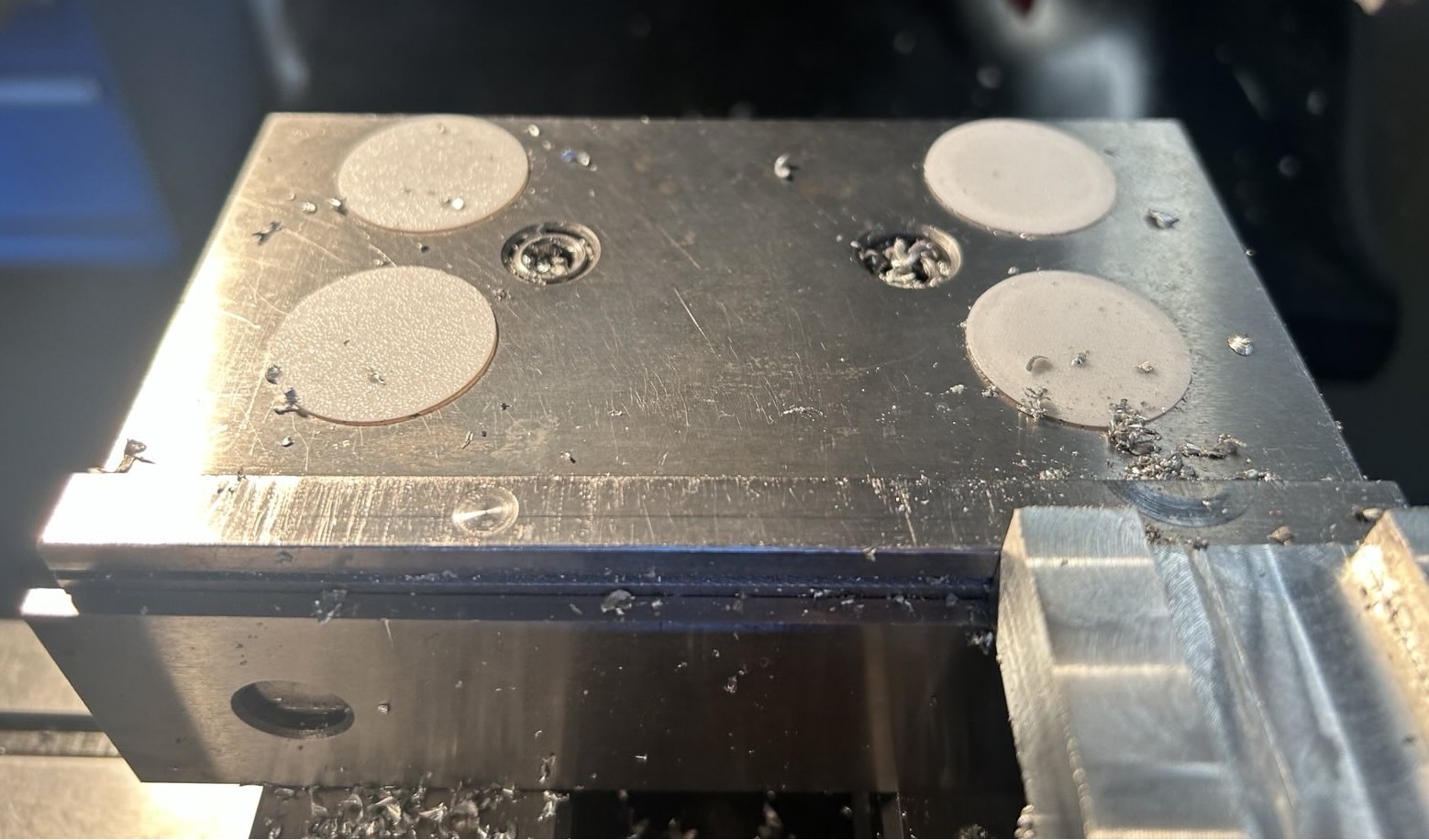
3D printed vise caps in use during one of the machining labs.
The caps were a good first try, but they weren't ideal for several reasons. Each hole is slightly different (even within one vise), meaning some caps fit a bit loose, and some would fit too tight. When brushing chips and coolant off the top of the vise, the loose fitting caps would be pulled out of place and coolant would fall into the holes, defeating the purpose of the caps. The tight fitting ones would pop out unexpectedly, also letting coolant and chips fall in. I abandoned the idea of individual hole covers and designed a cover for the entire top of the vice, which worked much better. The vise outer dimensions were also much more consistent across the five mills, meaning a single design worked for all five machines.
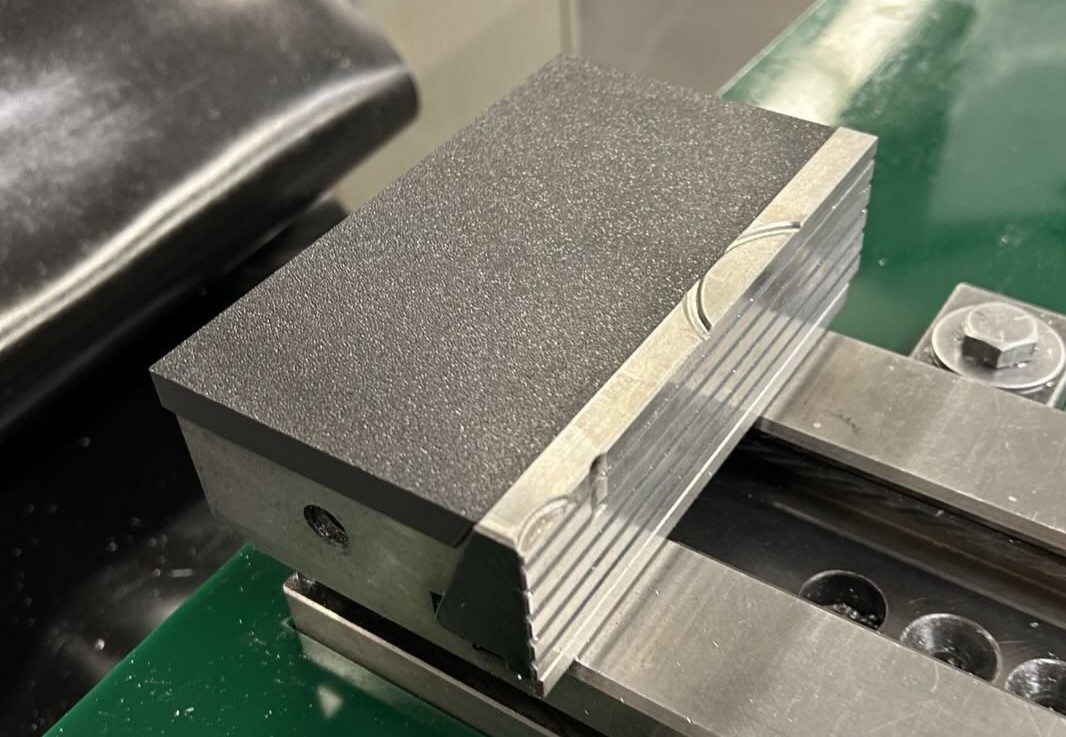
3D printed vise cover.
This article is a work in progress. More coming soon!